Bagaço v3: Now with PDFs and Wikipedia!
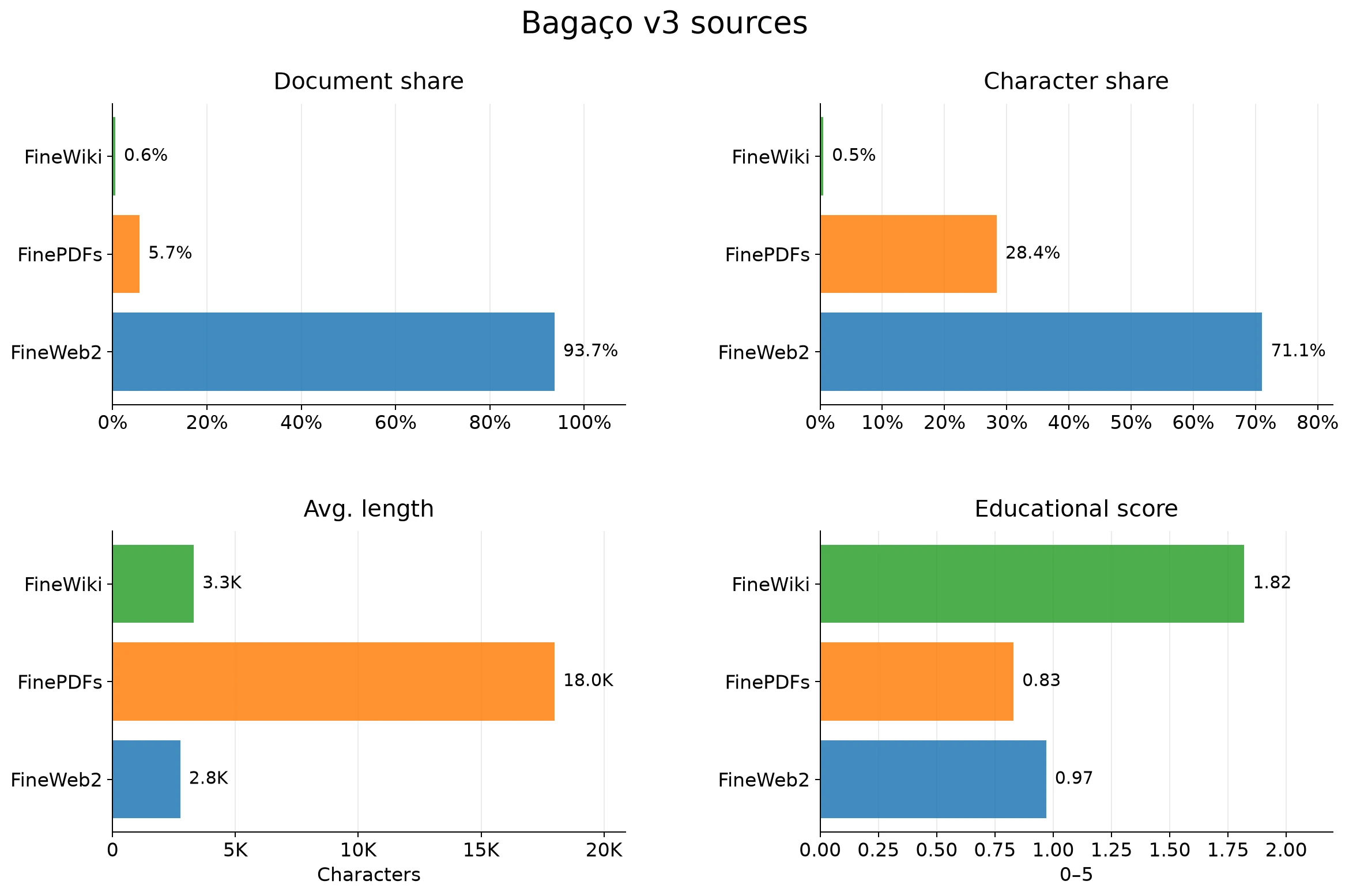
I'm proud to announce Bagaço v3, the third version of the largest European Portuguese pretraining dataset for large language models.
Why a new version? After my work on Ginjinha, one thing became pretty apparent: Bagaço was large and diverse, but lacked high-quality data. I believe Bagaço v3 fixes that.
This new version builds on top of Bagaço v2 and the great work from the Hugging Face team, and adds documents from Wikipedia (FineWiki) and from PDFs across the web (FinePDFs). But that's not the full story. Let's get into the details.
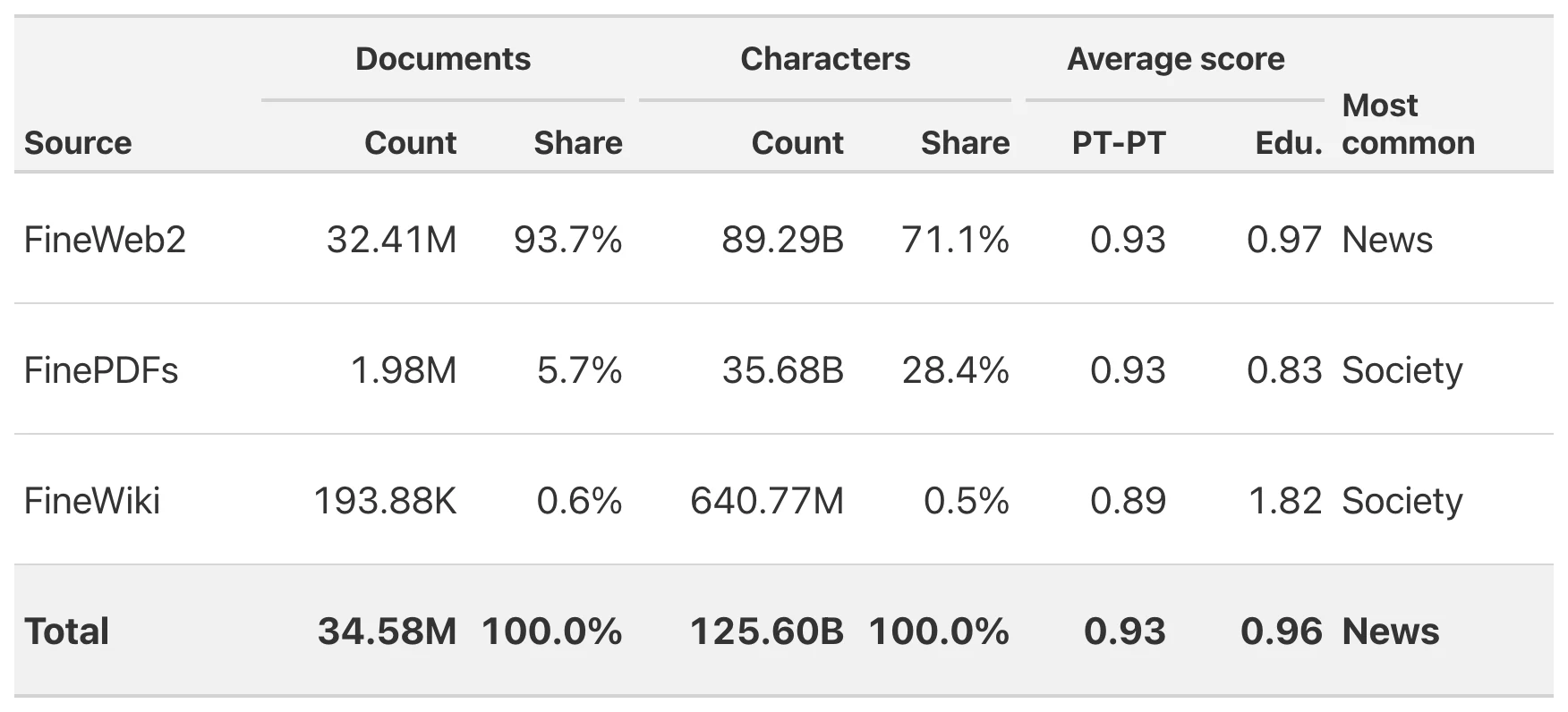
To create Bagaço v3, I started by using DataTrove to build a pipeline that merged Bagaço v2 (originally from FineWeb2), FineWiki, and FinePDFs. It filters the last two by European Portuguese score (using my own classifier, which I wrote about here), and deduplicates everything using MinHash deduplication.
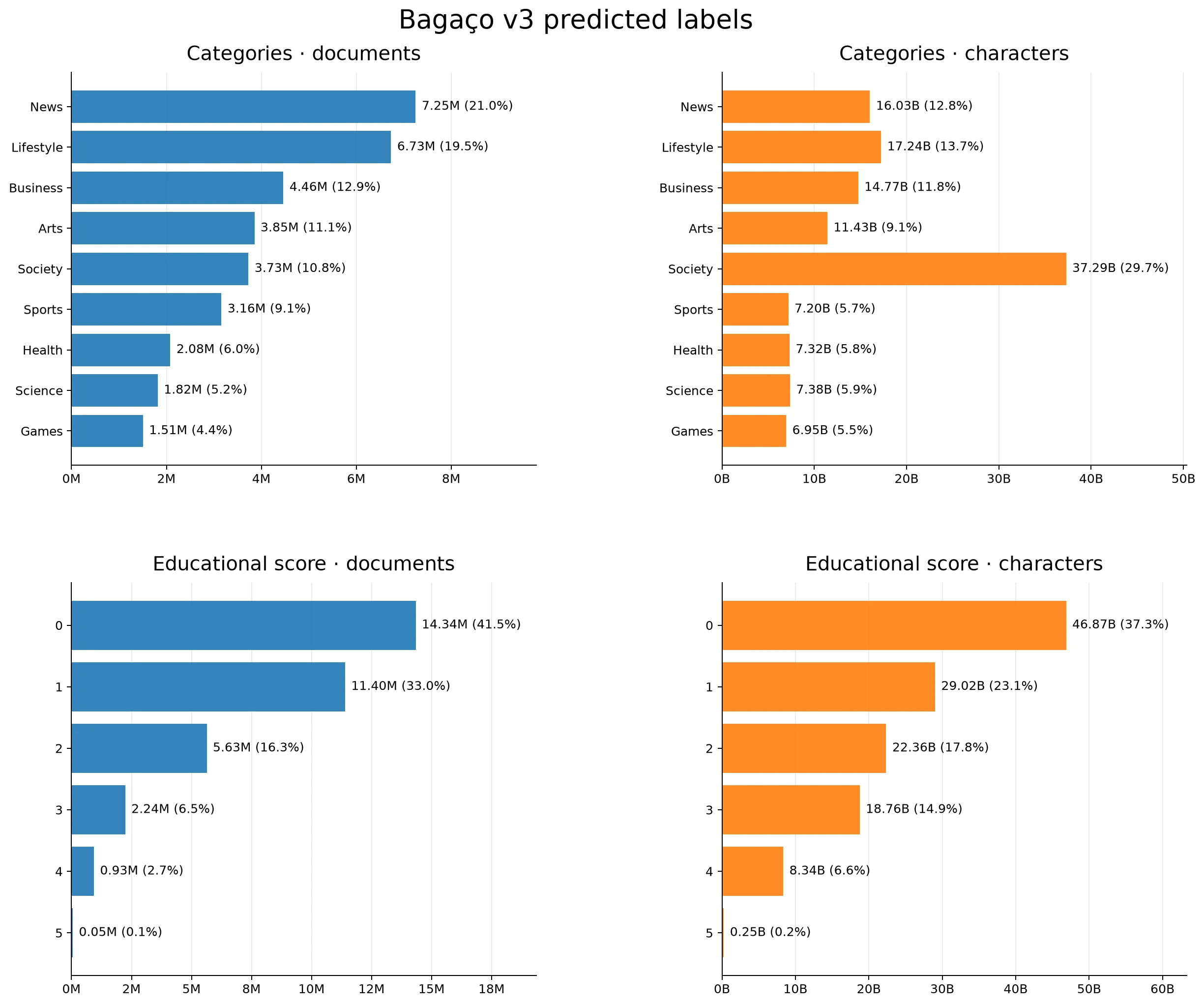
But we don't want to dump everything into the same place just like that. Just like Bagaço v2, v3 adds two dimensions to this dataset: educational score (from 0 to 5) and category (Arts, Business, Games, etc.). To get this done, I used Gemini 3.7 Flash and OpenRouter's batch API and started by annotating 36K documents with the following prompt:
Below is an extract from a web page. Evaluate whether the page has a high educational value
and could be useful in an educational setting for teaching from primary school to grade school
levels using the additive 5-point scoring system described below. The text will be in Portuguese.
Evaluate its educational value based on content quality, not language.

- 1 point: basic information relevant to educational topics, even with ads/promotional material.
- 2 points: addresses elements pertinent to education but doesn't align closely with standards.
- 3 points: appropriate for educational use, introduces key concepts relevant to school curricula.
- 4 points: highly relevant for grade school education, clear writing, substantial content.
- 5 points: outstanding educational value, perfectly suited for primary/grade school teaching.

The extract:
<extract>
{document_text}
</extract>

After examining the extract, briefly justify your total score (up to 100 words)
and provide the educational score (0-5). Also classify the extract into one category: Society,
Arts, Business, Science, Sports, Lifestyle, Health, Games, or News.

Respond ONLY with a JSON object in this format:
{"justification": "up to 100 words", "educational_score": 0, "category": "category"}

Examples of good responses:
{"justification": "The extract clearly explains photosynthesis and its role in plant growth, with useful scientific concepts for students.", "educational_score": 4, "category": "Science"}
{"justification": "The extract is mainly a product listing and offers little explanation beyond basic promotional information.", "educational_score": 1, "category": "Lifestyle"}
With that annotated dataset, I used the classic embeddings + LogisticRegression to train a classifier and apply it to the whole dataset. 4× RTX 4090s and 2 hours later, I had the entire dataset annotated. After some testing and many experiments with pi-autoresearch, an extension inspired by Karpathy's autoresearch project, I didn't find anything that really beat it.
Bagaço v3 adds ~2 million documents to the 32M documents from Bagaço. Why the effort for a 7% increase? If you look closely - even though we only add 2M documents, the character increase is around 40% (!). And that might very well translate into many more tokens. Bagaço v3 has an estimated 29 billion (!) tokens. And hopefully, many more high-quality ones.
And there we go - a shiny new dataset. Now all we have to do is train on it (again).